Oh how I love a good cashmere sweater. No other knit feels as indulgent and or keeps you as warm without adding bulk. I have one reliable cashmere sweater (that was gifted to me) and I reach for it again and again when the temperatures drop.
Receiving that sweater as a gift spared me the challenge of finding a good one for a reasonable price. That’s a tough job because cashmere can be hit or miss at lower price points. You can find affordable cashmere sweaters that feel like luxurious investment pieces, but the more common find is a cheap knit that pills after one afternoon of wearing.
- High-quality cashmere is defined more by fiber length and construction than by a high ply count.
- Check softness, resilience, pilling, seams, and fiber content to spot quality before you buy.
- Shop post-holiday sales to find better cashmere at 50% to 70% off.
So when you’re shopping cashmere on a budget, it pays to know how to test the fabric for quality before you buy or before that return window closes.
What is cashmere?
Cashmere is a fine natural fiber harvested from the soft undercoat of cashmere goats. The fiber takes its name from the Kashmir region, though most of the world’s cashmere comes from the high-altitude plains of Mongolia and China. The harsh climates in that region are thought to produce the finest, densest undercoat.
The fineness of the fibers gives cashmere its signature feel: lightweight, warm, and luxurious. Cashmere fibers measure 14 to 19 microns in diameter, while sheep’s wool fibers are usually 20 to 30 microns or more.
The “ply” debate
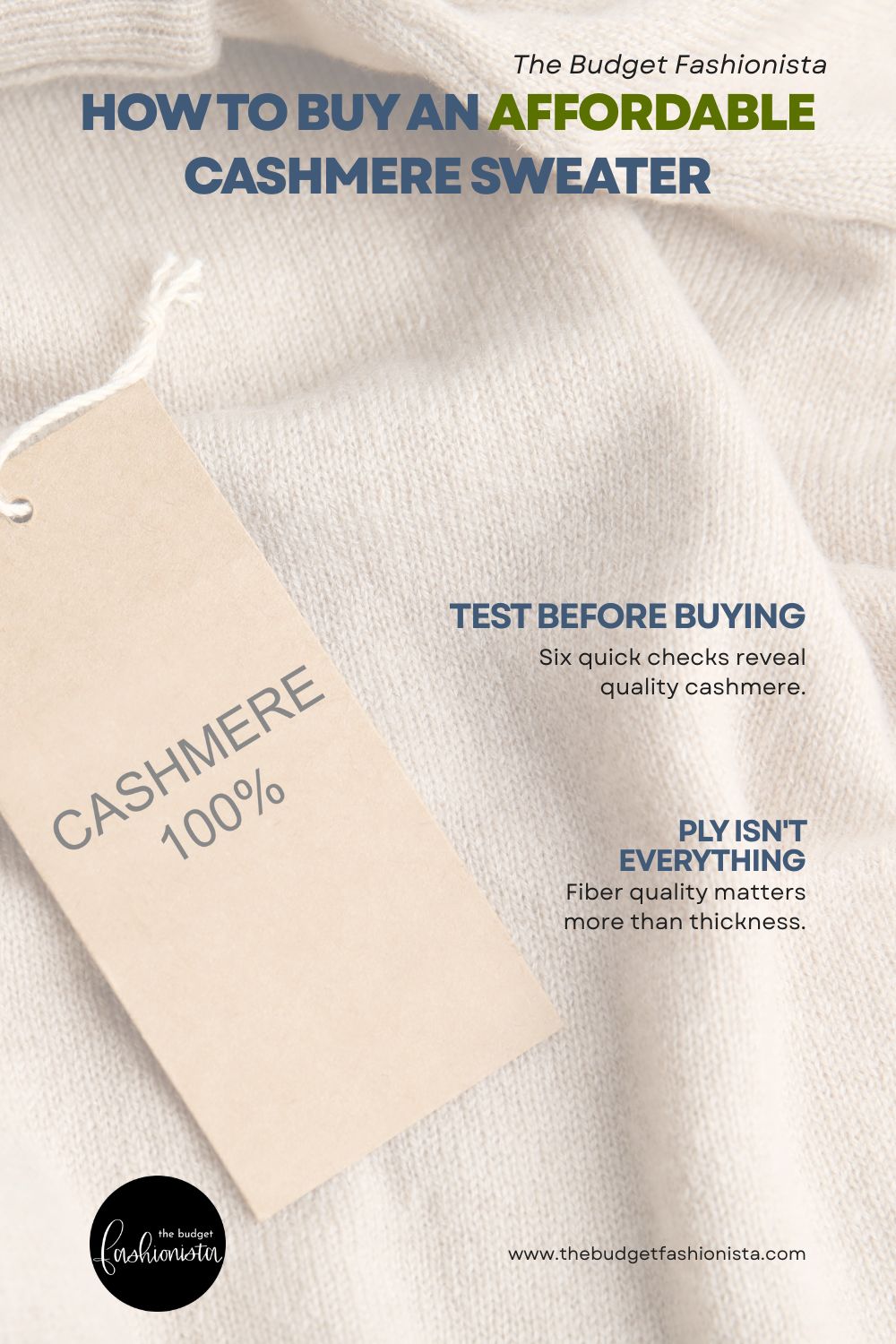
Ply refers to the number of yarns twisted together before knitting. Two-ply is the most common for sweaters, and four-ply or higher creates a thicker, heavier garment. But a higher ply does not automatically mean better quality. A beautifully made sweater using long, premium fibers will usually outperform a poorly made four-ply sweater.
So you can check the ply of sweaters you’re shopping, but don’t make decisions based on that alone. You’ll be happier with your purchase if you also inspect the fiber itself and how the sweater is constructed.
The quick 6 cashmere test
Six quick checks can tell you whether an affordable cashmere sweater is a budget find or a budget fail.
- Feel for a natural softness. Great cashmere feels soft but not unnaturally so. It shouldn’t be slippery or silky. Be wary if the softness feels off. Manufacturers sometimes wash or chemically treat lower-quality cashmere to make it feel luxurious initially. Unfortunately, that softness may disappear after a few wears.
- Check for spring-back. Gently squeeze part of the sweater in your hand for a few seconds, then let go. Quality cashmere springs back quickly. If deep wrinkles remain, the fibers aren’t particularly resilient.
- Rub for fuzz. High-quality cashmere can pill during its first few wears as loose surface fibers naturally work themselves free. Lower-quality cashmere made of shorter fibers can pill excessively. To test, rub two sections of fabric together lightly. If large, fuzzy balls appear immediately, the sweater may be woven from shorter fibers. Shorter fibers tend to pill more throughout the garment’s life.
- Stretch gently. Hold the sweater between your hands and gently pull. Good cashmere should return to its original shape. If the knit feels loose or permanently stretched, it may lose its shape quickly after washing.
- Check the seams. Turn the sweater inside out. You want to see even stitching, clean finishing, smooth shoulder seams, and no loose threads. Better sweaters usually have more careful construction, which helps them last for years.
- Read the fiber label. A sweater labeled 100% cashmere contains only cashmere fibers. This is what you want to see if you prefer maximum softness. But, you may be quite happy with a blend as well. Cashmere blended with merino wool, silk, or cotton may be less expensive, more durable, and easier to maintain. If you’re buying an everyday sweater, a quality blend may be the better value.
The best time to buy cashmere
Traditionally, the best markdowns happen between Christmas and March. Shop those post-holiday sales, January clearance events, and floor-clearing deals that make room for spring collections. Expect limited color and sizing options and look for discounts of 50% to 70%.
Where to buy quality cashmere on a budget
Affordable cashmere is easier to find than it was 15 years ago. Some consistently good places to shop include:
- Nordstrom Rack. One of the best outlets for discounted premium brands.
- Saks Off 5th. Great for designer labels if you’re willing to hunt.
- TJ Maxx and Marshalls. Inventory varies widely, but you can occasionally score top brands at steep discounts.
- Quince. One of today’s best values for 100% Mongolian cashmere at direct-to-consumer prices.
- J.Crew. Known for classic cashmere sweaters in a wide range of colors and silhouettes. Wait for one of the frequent sitewide promotions rather than paying full price.
- Banana Republic. Offers elevated cashmere basics that often go on sale at the end of the season.
- Lands’ End. A dependable source for classic styles with frequent promotions.
Is expensive cashmere always better?
Not necessarily. Luxury brands may use longer fibers and superior construction, but you’re also paying for branding. Some moderately priced retailers produce excellent cashmere that lasts for years with proper care.
Make your cashmere last
You can extend the life of your cashmere with these practices:
- Fold instead of hanging to prevent stretching.
- Wash gently according to the care label.
- Use a cashmere comb or sweater stone to remove pills.
- Store clean sweaters with cedar or lavender to discourage moths.
- Rotate your sweaters rather than wearing the same one several days in a row.
You may also want to see our tips on unshrinking sweaters.
The Budget Fashionista takeaways
A classic cashmere crewneck, V-neck, or cardigan in a neutral color may become one of the hardest-working sweaters in your closet. And when you buy it on sale? Even better. That’s luxury the Budget Fashionista way.