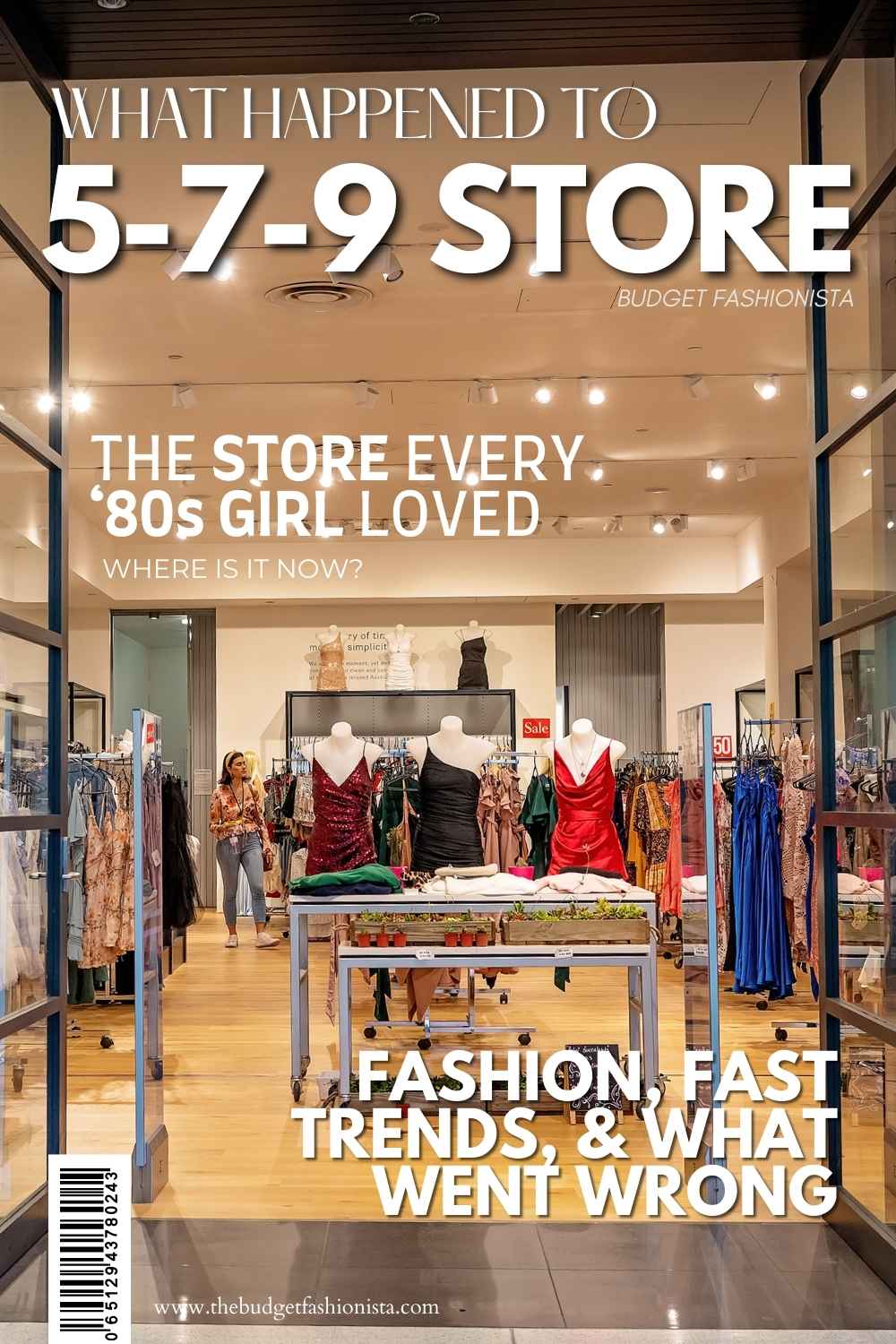
5-7-9 was a retail chain that catered to teenage girls in the 1980s and 1990s. In their day, 5-7-9 shops were wildly popular destinations at indoor malls around the U.S. Like other teen-focused retailers of that era, 5-7-9 did not survive the broader shift away from mall shopping.
Here’s the story of what happened to 5-7-9.
Read next: The evolution of the budget fashion landscape, and what’s next
Miami roots
5-7-9’s exact origin story is up for debate. Reports cite different launch dates and ownership information. Logopedia, which is questionable as a business source, says the first 5-7-9 shop opened in Miami in 1956. The location aligns with other reports related to the Edison Brothers Stores, a multi-brand retailer that purchased 5-7-9 shops in 1970.
At that time, the 5-7-9 chain consisted of 20 shops targeting teen girls and smaller-sized women. According to one report, some of the shops in certain markets may have been called Petite Street or Small Stuff. The store concept was to fill an unmet need for the smallest women’s sizes that were harder to find in mainstream stores. 5-7-9 clothes were low-to-mid range in terms of price and quality.
Edison Brothers, twice bankrupt
Under Edison Brothers Stores, 5-7-9 grew to more than 300 locations by 1993. The conglomerate owner was versed in mall-based retail. At one time, Edison Brothers Stores owned Bakers Shoes, Chandlers, Jeans West, Oak Tree, and Wild Pair. According to former CEO Martin Sneider, the company at one time ran 2,000 stores and collected more than $500 million in annual sales across its brand family.
The good times didn’t last. In 1995, Edison Brothers Stores, Inc. filed for Chapter 11 bankruptcy. As part of that filing, Edison told the courts it would close 500 unprofitable stores across its portfolio, including 70 5-7-9 shops.
Edison Brothers emerged from its first bankruptcy, but filed again in 1999. This time, Edison would part with the 5-7-9 brand, selling it to A.I.J.J. Enterprises, the holding company for Rainbow Shops. A.I.J.J. formed an operating company called The New 5-7-9 and Beyond, Inc. to manage the stores.
Read next: What happened to Wet Seal?
The New 5-7-9 and Beyond
Many 5-7-9 shops closed after the 1999 bankruptcy. There were a few standalone shops in Calexico, Colorado, Georgia, Massachusetts, Ohio, and Puerto Rico. The stores in Calexico, Colorado, Georgia, and Puerto Rico are closed, as of 2026. The Massachusetts and Ohio locations appear to have been rebranded as Rainbow Shops.
The 579.com URL was redirecting to Rainbowshops.com in 2025, but that redirect is now broken.
Where to shop instead of 5-7-9?
If you’re feeling nostalgic for low-priced teen fashion, the obvious next choice is Rainbow Shops, technically a sister brand to 5-7-9. Rainbow sells very trendy clothes in sizes ranging from 00 to 3X. You can buy bold parachute pants for $35, jeans for $20, and body-hugging knit dresses for $25.
Rainbow also has more than 900 stores around the U.S. You can find one near you on the brand’s store locator page.
The 5-7-9 size debate
5-7-9 is controversial today because the store carried an exclusive size range. The original version of this article focused entirely on that debate, which generated a lot of commentary from supporters and haters.
Here’s my take. I honestly don’t remember 5-7-9 stores being that exclusive. I was in high school from 1986 to 1990, and my memory tells me that sizes 5, 7 and 9 covered a large-ish chunk of the high-school-girl population.
Yes, the store excluded curvy girls, which stinks. But the sizing wasn’t so extreme that it only catered to the emaciated and underweight. I was 20 pounds heavier in high school than I am today, which was average-sized. I could wear a 7.
As a former 5-7-9 shopper, I never rejoiced the narrowly focused sizing, nor did I consider it a badge of honor that I could wear 5-7-9 clothes.
The ’70s and ’80s were rough on girls, for sure. The standards of female beauty were strange and severe, like Michelle Pfeiffer in Scarface. 5-7-9 stores were a product of that toxic environment, not the cause.
Read next: What happened to Contempo Casuals?
Why 5-7-9 failed
5-7-9 found success at a time when skinny was in and teen girls spent their downtime at the mall. As U.S. mall traffic declined over the 2000s and 2010s, that steady stream of walk‑in discovery shoppers thinned. The model — trend‑driven, impulse‑friendly, and reliant on physical locations — became harder to sustain.
A teen customer base ages out quickly. And when the next generation found the mall less interesting, 5-7-9 couldn’t maintain its relevance. It didn’t have anything to fall back on, no strong digital presence or clear differentiation.
The ownership structure didn’t help, either. Edison Brothers managed multiple mall‑based fashion brands. Attention and capital must have been spread thin, limiting the focused reinvention 5-7-9 would have needed to survive.
In short, 5‑7‑9 was squeezed by declining mall traffic, generational shift, and divided corporate focus.