You know my philosophy on spending: You don’t conserve your cash by buying cheap stuff. You do it by focusing on value. And value is the relationship between what something costs to buy and how much you use it.
- Learn how to apply the cost-per-wear formula to cosmetic surgery and other big purchases.
- Compare the long-term value of a permanent procedure with the ongoing cost of temporary beauty fixes.
- Discover when cosmetic surgery can be a financially responsible investment and when it isn’t.
That value equation underpins my cost-per-wear philosophy. If you can estimate how much you’ll wear a new top, you can assess its value relative to the price. Simply divide that price by the potential number of wears. A $200 jacket worn 100 times has a low cost-per-wear of $2, while a $50 top you wear once cost you $50 for a single use. The jacket is the better buy.
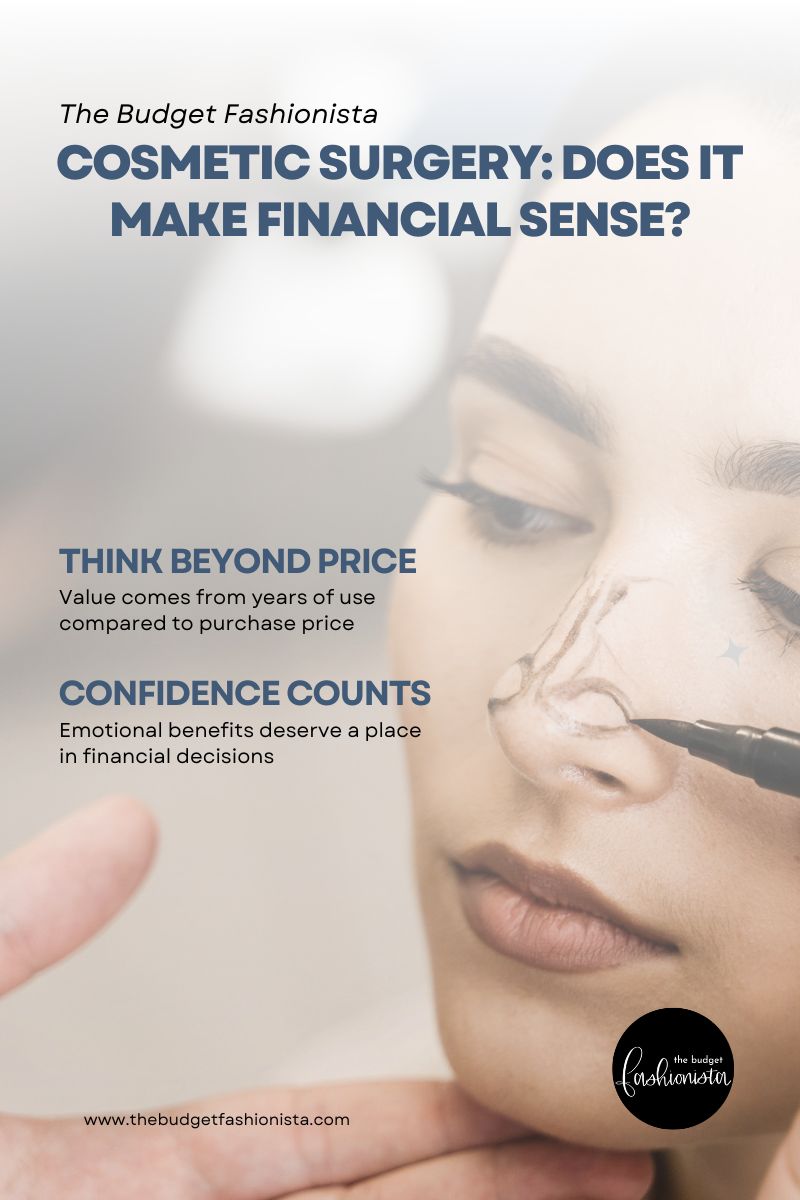
You can apply this value formula to any purchase, small or large: lipstick, a new car, and, yes, even cosmetic surgery. A cost-per-use analysis becomes particularly interesting when you apply it to big investments. It forces you to decide what you want to achieve with the purchase, which can help you make a more practical and less emotional decision.
Read next: Can fashion beat finance? How luxury handbags performed against stocks
Cost-per-wear applied to cosmetic surgery
According to the most recent Complete Plastic Surgery Statistics report, the most popular facial procedures are eyelid surgery, facelifts, and nose reshaping, aka rhinoplasty. Let’s use rhinoplasty as our test case because it has appeal among the widest range of women and men.
Cost
A rhinoplasty procedure can cost $5,000 to $15,000, depending on the surgeon, the complexity of the procedure, and where you live. The American Society of Plastic Surgeons pegs the average rhinoplasty cost at $7,637.
Use
The “use” you’ll get from a nose reshaping is unlimited. The results are permanent and, assuming you love the result, you’ll “use” and enjoy your new nose for the rest of your life.
Forgive me for getting morbid here, but the average lifespan for a woman in the U.S. is 81.4 years. Say you’re exactly 28 today. Going by the average, you have more than 19,000 days to enjoy that new nose even after accounting for the recovery period. The cost-per-day for the procedure works out to somewhere between $0.26 and $0.76.
You could also work out a more conservative analysis based on a set timeline. A $7,637 investment works out to $4.18 per day for five years or $2.02 daily for 10 years.
The cost of beauty workarounds
The analysis gets more interesting if you’re spending money on makeup to contour your nose daily. You’re buying a good contour palette or stick, concealer, highlighter, setting powder, plus brushes, sponges, and setting sprays. You could be spending $30 monthly, which adds up to $3,600 after 10 years.
And then there’s the time you spend applying that makeup. Ten minutes a day equates to 60 hours a year, on one makeup step that you wash off every night.
Read next: Why am I broke? An expert answers
The confidence factor
Think about the clothes you wear most often. It’s likely you feel confident wearing those pieces. That’s why they’ve earned a regular spot in your rotation. In the cost-per-wear formula, the confidence factor encourages more “wears,” which makes the purchase more efficient over time.
The math doesn’t work the same way for a cosmetic surgery analysis, because you can’t help but wear a reshaped nose or newly lifted eyelids. Even so, renewed confidence has value. Research indicates that not liking an aspect of your face can be draining. You might feel uneasy about photos, video calls, and social gatherings. Over time, those feelings can lead to low self-esteem, anxiety, and depression. That mental energy has a cost too, even if it does not show up on a credit card statement.
Research also finds that rhinoplasty in particular can improve quality of life, self-esteem, and anxiety symptoms in well-adjusted people. You can’t quantify that value of that in terms of dollars, but it has value.
Read next: The big budgeting mistake you might be making and how to fix it
Value case for cosmetic surgery
To be clear, I am not saying you should run out and get your nose done, face lifted, or tummy tucked. But an expensive procedure can make sense for you financially when all of these are true:
You are self-conscious. You worry about how you look in different situations, and you’re regularly spending on temporary fixes that aren’t very effective.
You are confident the procedure will boost your self-confidence. You’ve done your research, interviewed surgeons, asked questions, and confirmed outcomes. That last one can come in different forms, such as analyzing rhinoplasty before and after photos or conversing with other women who’ve had the same procedure.
You can afford it. If you are behind in your rent or struggling to buy groceries, now isn’t the time for a big investment. Consider reworking your budget so are meeting your regular obligations first. Then start a savings fund for your planned procedure.
Should you finance cosmetic surgery?
Many board-certified plastic surgeons offer payment plans or work with medical financing companies that break the cost into monthly installments. A $7,500 procedure financed over 24 months comes out to roughly $312 per month before interest. That is less than many women spend on beauty subscriptions, salon visits, skincare products, and makeup combined in a given month. It is not pocket change, and interest charges increase the investment. But the spend may be closer to your existing beauty budget than you thought.
Still, this is a major purchase that requires spending discipline. Here’s a solid approach:
- Set a timeline.
- Budget an amount to save monthly.
- Know what you are spending in cash and time on beauty workarounds. You may need to track your current beauty spending for a month or two.
- Research your options. Seek a realistic expectation of the outcome and its permanence.
- Make a clear-headed judgment: Is the cost worth it? Then, wait a week and think it over again. If you come to the same answer, it’s probably the right one for you.
Read next: The Budget Fashionista’s intro to budgeting
The Budget Fashionista takeaway
Being financially responsible does not equate to depriving yourself of luxury. In my view, being financially responsible enables indulgence in a way that’s sustainable.
So if you’re dreaming of a different nose or smoother eyelids, do the research. Learn your options and the costs. Consider how your current beauty routine may change. Think about the confidence factor and what that may be worth to you. Then you can make the decision the way a Budget Fashionista would: with the full picture in front of you.